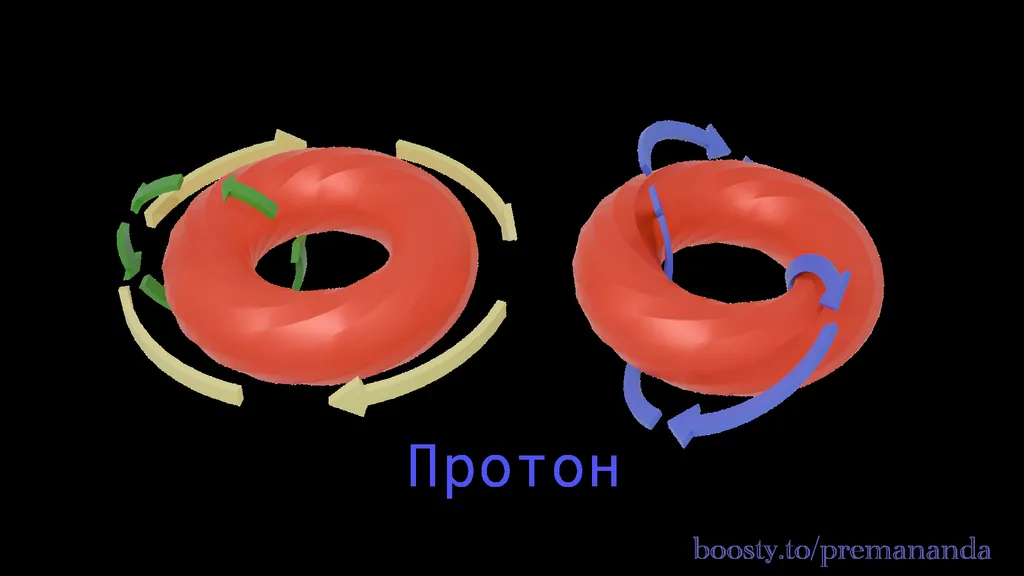
The Anatomy of Matter: Proton, Electron, and Neutron. No Magic — Only Hydrodynamics. Part 10
“A particle is not an object. A particle is a process.”
— Etherdynamic approach
We are accustomed to physics textbooks drawing elementary particles as little spheres. The electron is a small sphere, the proton is a large sphere. But when you ask: “What is this sphere made of?”, science responds: “It is a fundamental particle; it has no internal structure, only mathematical properties.”
We are asked to believe in “spin,” which rotates but rotates nothing. In “mass,” which comes from nowhere. In “wave-particle duality,” where an object is simultaneously a point and a wave.
Etherdynamics offers a different approach. A particle is a stable vortex in a medium (the ether). And the most surprising thing is that official science has already studied these vortices, it just calls them something else — quantum vortices in a superfluid medium.
Let’s break down the “Trinity” of matter — Proton, Electron, and Neutron — from a mechanical perspective.
📊 What Official Science Says
A brief comparison of the three main particles that make up all matter:
| Characteristic | Proton ($p^+$) | Neutron ($n^0$) | Electron ($e^-$) |
|---|---|---|---|
| Location | In the atomic nucleus | In the atomic nucleus | Orbits the nucleus |
| Electric Charge | $+1$ | $0$ | $-1$ |
| Spin | $1/2$ | $1/2$ | $1/2$ |
| Mass (Relative) | $\approx 1$ amu | $\approx 1$ amu | $\approx 1/1836$ amu |
| Internal Structure | Complex (quarks) | Complex (quarks) | Elementary |
Key Facts:
- Mass Scale: The proton and neutron are the “heavyweights.” Almost all of the atom’s mass (99.9%) is concentrated in the nucleus. The electron is incredibly light.
- Charge: The proton ($+$) and electron ($-$) attract each other — this holds the electrons around the nucleus. The neutron has no charge; its role is as “glue,” helping protons stay together.
- Spin 1/2 for all three makes them fermions — they make up solid matter and cannot occupy the same point in the same state (thanks to this, atoms have volume).
📐 Etherdynamic Perspective: The Proton
The Proton — An Armored Torus
The proton is a complex vortex torus. Imagine that a vortex tube has not just closed into a torus but has a complex internal structure and has compacted to the limit.
- Why is it stable? A torus is a stable formation in a superfluid medium. Its topology protects the proton from decay. This is why protons live for billions of years.
- Where does mass come from? In hydrodynamics, mass is a measure of the medium’s resistance. The proton is a super-dense formation that arose due to the complex internal topology of the vortex.
Two Types of Rotation
Imagine a toroidal vortex (a donut). It has two rotations simultaneously:
- Toroidal: rotation of the ring like a wheel (around the central hole).
- Poloidal: rotation of the “skin” of the donut itself (turning inside out).
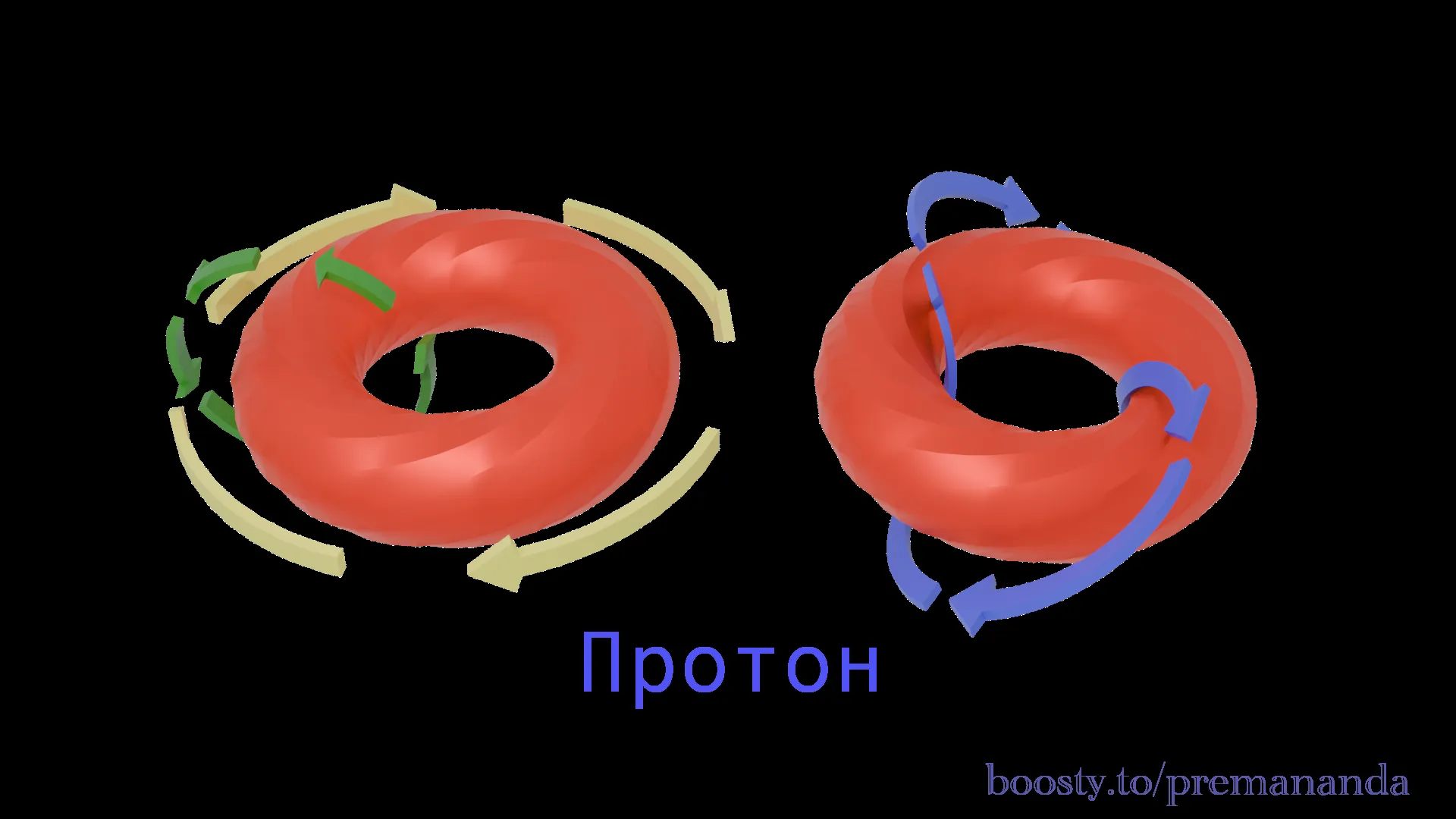
Spin 1/2 means that the proton makes 2 rotations of the “skin” for 1 rotation of the “ring.” This is a geometric ratio of flow velocities.
The Proton is a Pump
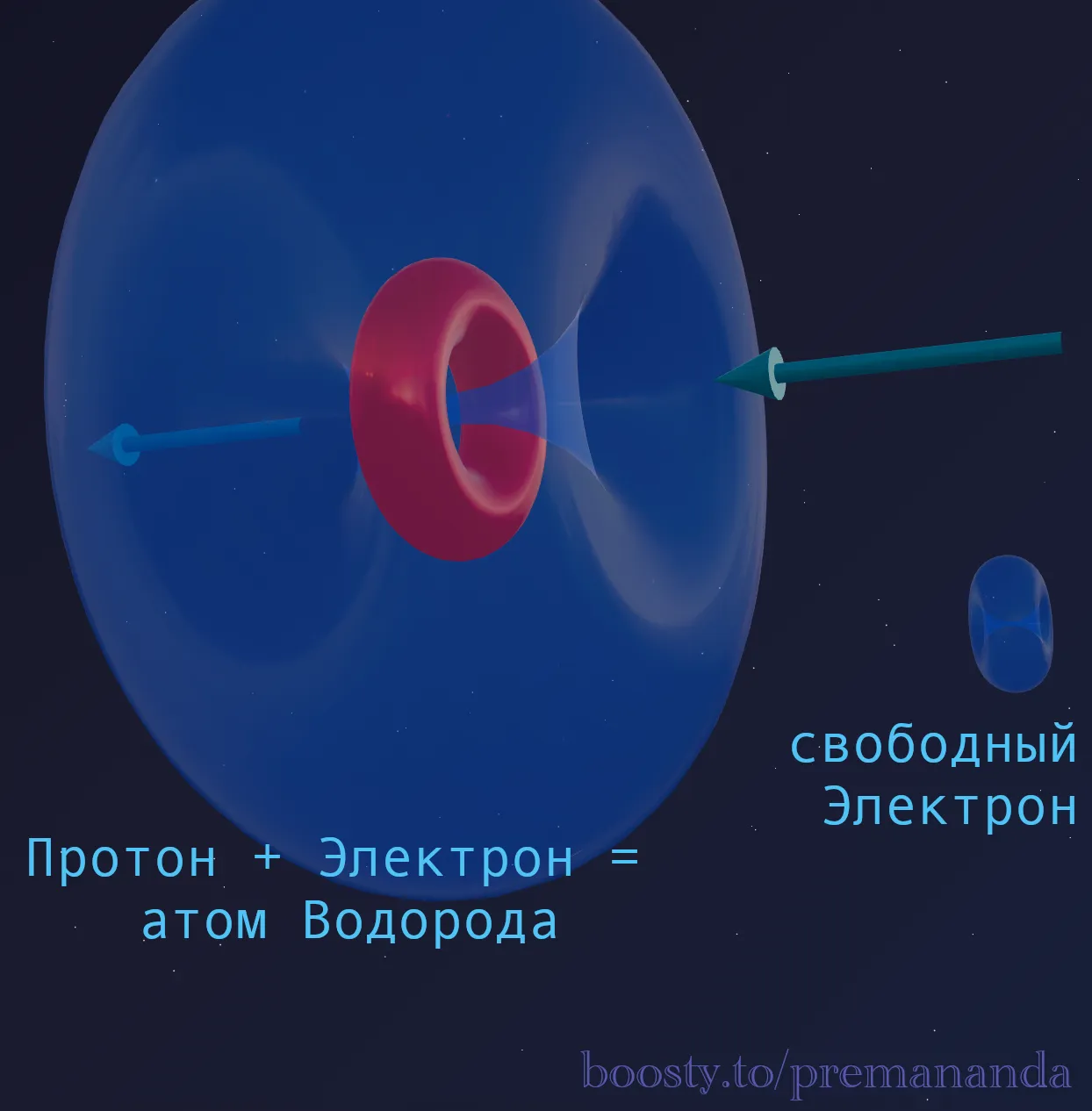
The proton is obligated to “pump” ether through its internal opening. A funnel forms on one side, and a fountain of ether on the other. When these flows close into a long loop — the electron manifests.
📐 Etherdynamic Perspective: The Electron
The Electron — A Shaking Donut
The electron is a simple toroidal vortex (vortex ring). Imagine an ideal smoke ring, but consisting of ether.
The electron has a simple structure — it is a torus that is 1836 times lighter than a proton.
- Why is the electron a wave? A vortex ring is never perfectly rigid. Vibrations constantly travel along it — so-called Kelvin waves. The electron flies and shakes like a living spring. The frequency of this shaking is what physicists call the “de Broglie wave.”
- The Size Paradox: Why is the electron large within an atom but small in a free state? In the atom, its structure is “inflated” by the proton pump. In free flight, it compresses under the influence of external ether pressure.
📐 Etherdynamic Perspective: The Neutron
The Neutron — A Trojan Horse
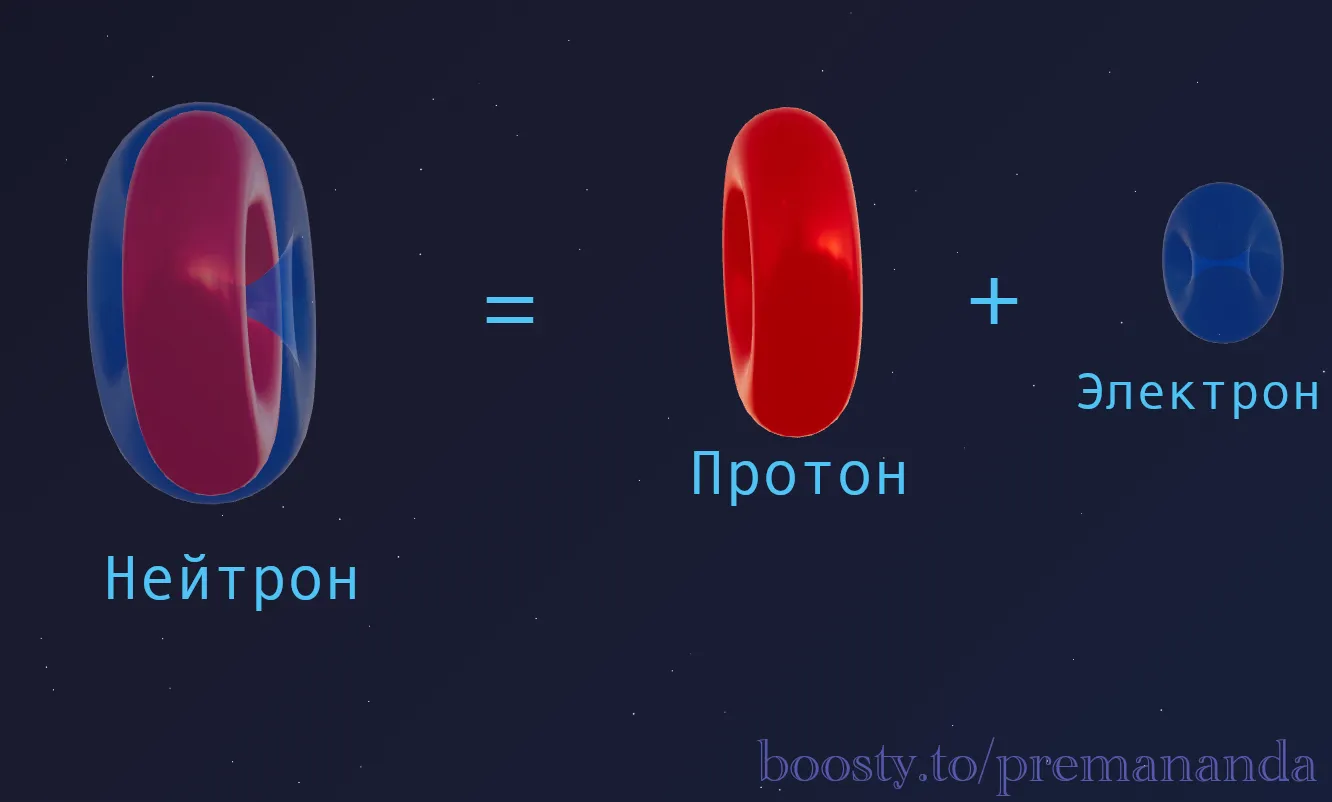
In our model, Neutron = Proton + Electron (in a compressed state).
Imagine a proton as a powerful pump. Under certain conditions, an electron can compress around the proton. The result is a neutron.
- Charge Disappears: Charge is the direction of ether movement. The “plus” of the proton is compensated by the “minus” of the electron. The system becomes neutral.
- Mass Increases: The neutron is heavier than the proton by exactly the mass of the electron + the mass of the additional ether set in motion.
Why does the Neutron Decay (Beta Decay)?
The neutron is a compressed spring. Inside the nucleus, its neighbors hold it, but once pulled outside, the external “vices” disappear. Vibrations (Kelvin waves) loosen the structure, and a breakout occurs.
BANG!
- The Electron shoots outward (beta radiation).
- The Proton remains (the pump starts working openly).
- A longitudinal wave travels through the ether from the rupture — a disturbance in the medium’s density. Science calls this wave a neutrino.
🔑 Summary
We do not live in a world of abstract formulas, but in a world of understandable mechanics:
- The Proton is a torus with complex topology (an armored pump).
- The Electron is a simple torus (a shaking donut).
- The Neutron is their temporary union (a Trojan horse).
All “quantum mysteries” — spin, wave nature, mass, charge — receive a clear mechanical explanation through the dynamics of vortices in the superfluid ether.
🔮 What’s next?
In the next part — Brownian Motion:
- Why are molecules in constant chaotic motion?
- How does the ether explain heat and temperature?